MATERIALS

The call for proposals
Materials x Space is now open!

Materials x Space

Why Phi-Lab at ESDI

The Phi-Lab at the European Space Deep-Tech Innovation Centre (ESDI) aspires to transform breakthrough science into real-world solutions. 
The approach based on use-inspired research, combined with deep-tech
competence in our ecosystem, promises that developments are scientifically excellent, commercially relevant and have potential market impact. We expect that this accelerates progress from laboratory demonstrations to market-ready products that meet the demanding standards of space, but also terrestrial applications.

The big question:

What if spacecraft structures could adapt, shield, and self-heal in orbit, enabled through advanced manufacturing?

The Problem:

Next-generation advanced manufacturing (AM) could transform how we build and maintain space structures – from satellites and spacecraft to stations, habitats, and protective panels – by enabling on-demand fabrication, adaptive components, and self-healing materials. Yet these capabilities remain largely confined to laboratories and small-scale demonstrations. Without breakthroughs, space systems continue to depend on static parts and complex legacy fabrication, limiting progress in re-entry protection, radiation shielding, and autonomous in-orbit repair, while also constraining translation into terrestrial markets.

The Current State:

Advanced manufacturing has reshaped prototyping and lightweight part production, but next-generation AM for extreme environments is still in its infancy. Most components remain single-material with limited tolerance to temperature, radiation, and stress. Hybrid builds across metals, ceramics, and polymers often fail at interfaces, while architected and 4D-printed lattices show promise but degrade under thermal shock. Autonomous, closed-loop AM processes are only beginning to mature. Commercial AM already supports aerospace with brackets, housings, and propulsion parts, but the opportunity lies in innovative, next-generation AM that delivers multifunctional, adaptive, and durable structures for space -such as skins that integrate protection and thermal control, or panels that can reconfigure and repair in orbit – while unlocking commercially relevant products on Earth.

The Challenge:

Achieve a step change in AM: opening entirely new research directions and enabling extreme-environment performance that today’s methods cannot approach. The goal is to move beyond incremental improvements and deliver a new generation of printable, certifiable, and commercially relevant structures. Key objectives must target advances such as:

  • Thermal resilience: pioneer materials and structures that maintain performance under extreme high-temperature conditions and repeated thermal cycling, opening AM to environments previously unreachable.
  • Radiation/EM protection: integrate radiation shielding and EMI/EMC resilience directly into printed structural structures, creating a new class of multifunctional AM surfaces.
  • Robustness under stress: advance AM parts that remain durable under cryogenic–hot cycling, micrometeoroid impacts, and abrasive dust – conditions that conventional AM cannot yet address.
  • Autonomous build & repair: establish autonomous, closed-loop AM and in-situ inspection methods, paving the way for self-certifying and self-repairing structures.
  • Multi-material fidelity: enable reliable, graded interfaces across metals, ceramics, and polymers, unlocking new research directions in multifunctional and adaptive composites.
  • Commercial pathways: demonstrate commercial use potential and scalable manufacturing, positioning next-generation AM as a commercially relevant field for both space and terrestrial markets.

In line with our commitment to sustainability, new approaches should also consider resource efficiency and reduced environmental impact across the full manufacturing lifecycle.

The Solution:

We seek breakthrough approaches that open new fields in advanced manufacturing for extreme environments. Areas of interest include:

  • Hybrid & multi-material printing: functionally graded metal–ceramic–polymer systems with robust interfaces.
  • Adaptive skins: morphing structures, variable-emissivity surfaces, and embedded sensing/actuation.
  • Metamaterial integration: architected lattices for tailored thermal, EM, and radiation performance.
  • Autonomous manufacturing & repair: closed-loop process control with in-situ qualification, and on-orbit repair methods.
  • Extreme feedstocks: printable ultra-high-temperature ceramics, radiation-resistant polymers, and lightweight multifunctional composites.
  • Digital thread & qualification: physics-informed digital twins linking process to performance, and accelerated pathways to certification.

The harsh space environment serves as the ultimate testbed: technologies meeting these requirements will naturally translate to terrestrial commercial applications. Advances should therefore show clear pathways toward manufacturable, certifiable systems and their commercialization with examples ranging from:

  • Adaptive spacecraft structures that flex to deploy, stiffen to protect, and heal damage in orbit.
  • Re-entry shields and hot-structure panels with integrated sensing and cooling.
  • Radiation- and EM-shielded structural panels combining communication and protection functions.
  • Autonomous in-orbit manufacturing and repair capabilities.
  • Cryogenic tanks and heat exchangers with long cycle life.

Self-repairing space structures extend mission lifetimes, reduce space debris, and lower environmental impact through fewer launches.

Furthermore, additional terrestrial applications might also be enabled by such advancements, including for example:

  • Hypersonic and aero-propulsion hot sections.
  • Nuclear and concentrated-solar components.
  • Geothermal drilling and harsh-environment tools.
  • Lightweight multifunctional panels for aviation and energy systems.
  • Industrial and medical equipment needing high durability under stress.

Your application

Phi-lab Switzerland: Call for proposals

Check the requirements


Benefit from our pre-proposal support

Submit your application on OSIP

Submission closed on December 5th.

Evaluation process

and Final Evaluation:  Beginning of 2026

Budget and Additional Benefits

The total available Phi-Lab “Innovation Seed Funds” (See call documentation for details) for the implementation of this specific call is 2.97 MCHF.

The available budget per winning project is from a minimum of 200’000 CHF to a maximum of 990’000 CHF for a maximum duration of 24 months, with the average Innovation Seed funding per project expected to fall in the range of 600’000 to 750’000 CHF for 24 months.

The evaluation process

The process consists of the following main steps:

  • After the cut-off date for the application, a formal check of the application documents received takes place
  • If the application is found compliant with the requirements, the applicant will be invited to the Tender Evaluation Board meeting
  • The applicant gives a 10 – 15 min presentation to the Tender Evaluation Board, followed by a Q&A session
  • The Tender Evaluation Board evaluates the application
  • The ESA Phi-Lab provides feedback to the applicant and, if successful, an invitation to sign an incubation contract
 

Access the Call documents here

FAQ

Can I request a preliminary check before submitting my application?

To have your proposal reviewed and to assess its viability in relation to the call criteria, please contact Markus Schoelmerich at markus.schoelmerich@psi.ch.

The best way to stay updated on ESDI’s open calls and other news is by subscribing to our newsletter and following us on LinkedIn.

Phi-Lab Switzerland has one additional call planned on data, planned for 2026. This list may expand over time. To ensure you never miss an update, we recommend subscribing to our newsletter.

For any inquiries related to intellectual property, equity, or other contractual matters, please contact Markus Schoelmerich at markus.schoelmerich@psi.ch.

The ESDI team is available to support you with any technical questions you may have. Additionally, we collaborate with partners who possess specific expertise to ensure your questions are answered thoroughly. The first point of contact for technical inquiries is: markus.schoelmerich@esdi.ch.

The earliest possible start date (T0) for your project is once the contracts are signed, which we expect to happen by Spring 2026.

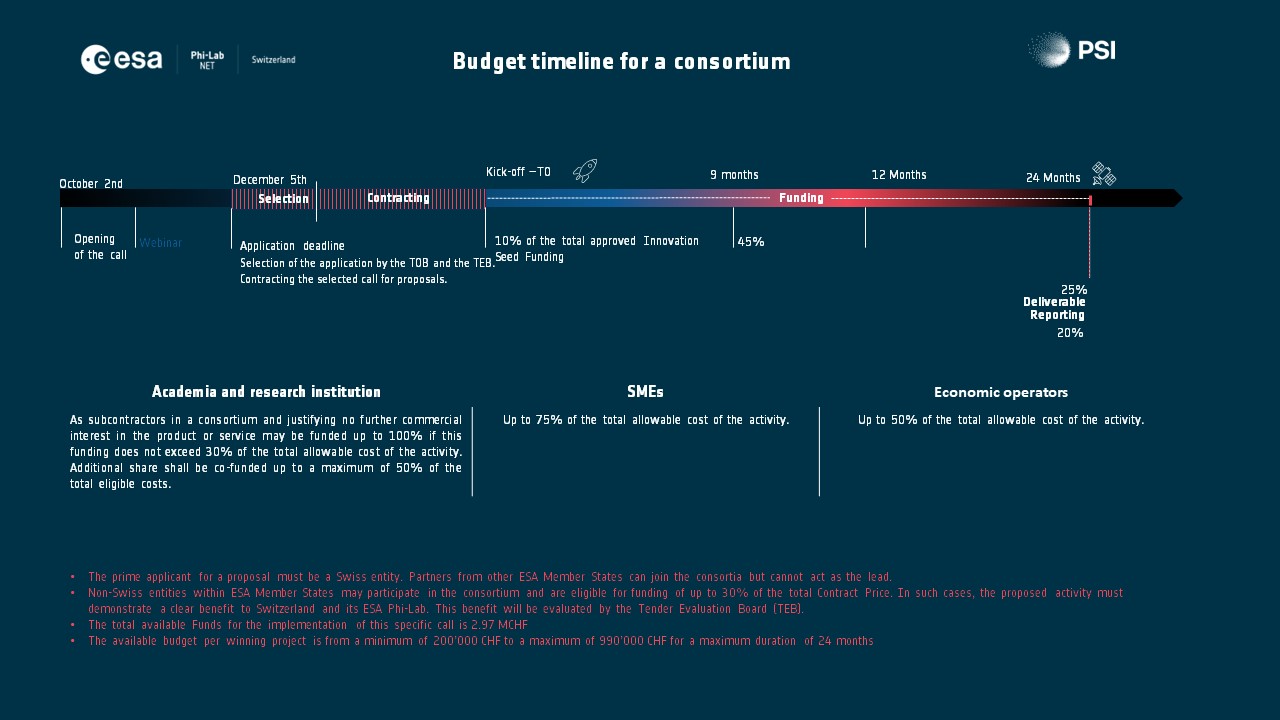
Funding overview

Download: Funding cycle for the Materials call

Have a look at the overiew of the funding cycle for a selected proposals. 

For any question according to the funding please check the attached document on the OSIP webpage or contact: markus.schoelmerich@psi.ch.