
MATERIALS
Space × Materials
AM-XTREME: Next-Generation Advanced Manufacturing for Extreme Environments
Projects are selected and the research programme has kicked off!
The Phi-Lab Switzerland Space × Materials Programme has officially launched its cohort activities, marking the beginning of a coordinated innovation effort focused on next-generation advanced manufacturing for extreme environments. The initiative brings together a diverse ecosystem of academic and industrial partners to accelerate breakthroughs in advanced manufacturing for both space and terrestrial applications. The call was open for 8 weeks and received 19 submissions, from which 4 projects were selected, involving a total of 15 organizations, including 4 newcomers to the Space and 6 first time collaborations.
The selected AM-XTREME: Next-Generation Advanced Manufacturing for Extreme Environments projects are:
CosmoClean
CSEM | Maana Electric | Megasol
Energy-harvesting, self-cleaning multifunctional surfaces for space exploration
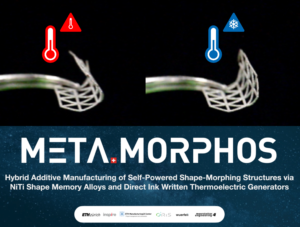
Meta.Morphos
ETH Zürich | Inspire | Oris Space | Meerstetter Engineering | Würfeli GmbH
Hybrid additive manufacturing of self-powered shape-morphing structures via NiTi shape memory alloys and direct ink-written thermoelectric generators
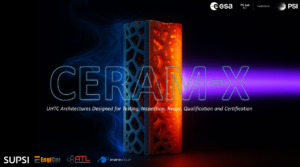
CERAM-X
SUPSI | EngiCer SA | Archer Technicoat Ltd | ArianeGroup
Computationally Engineered Refractories Additive Manufacturing for eXtreme Environments
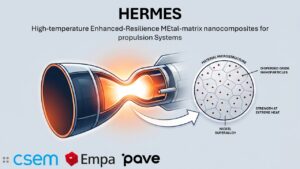
HERMES
CSEM | Empa | PAVE Space SA
High-temperature Enhanced Resilience MEtal-matrix nanocomposites for propulsion systems
We asked: what if spacecraft structures could adapt, shield, and self-heal in orbit, enabled through advanced manufacturing?
To address this challenge, the programme focuses on transforming how space systems are designed, built, and maintained. Next-generation advanced manufacturing (AM) holds the potential to enable on-demand fabrication, adaptive components, and self-healing materials for spacecraft, satellites, stations, habitats, and protective systems. However, these capabilities remain largely confined to laboratory-scale demonstrations. Without major breakthroughs, space systems will continue to rely on static architectures and legacy manufacturing approaches, limiting progress in areas such as re-entry protection, radiation shielding, and autonomous in-orbit repair, while also constraining transfer to terrestrial markets.
While advanced manufacturing has already reshaped prototyping and lightweight aerospace components, the next frontier “AM for extreme environments” is still in its early stages. Current solutions are typically limited to single-material systems with constrained tolerance to thermal, mechanical, and radiation extremes. Hybrid multi-material structures often fail at interfaces, and while architected lattices and 4D-printed materials show promise, their durability under harsh space conditions remains insufficient. Autonomous, closed-loop manufacturing and in-situ repair are emerging but are not yet mature enough for deployment.
The challenge addressed by this call is therefore to achieve a step change in advanced manufacturing: moving beyond incremental improvements toward a new generation of printable, certifiable, and commercially viable structures capable of operating in the most demanding environments.
Key objectives include:
- Thermal resilience: enabling materials and structures that maintain performance under extreme temperature gradients and repeated thermal cycling.
- Radiation and electromagnetic protection: embedding shielding and EMI/EMC resilience directly into structural materials.
- Mechanical robustness: ensuring durability under cryogenic-to-high-temperature cycles, micrometeoroid impacts, and abrasive environments.
- Autonomous manufacturing and repair: advancing closed-loop AM systems with in-situ inspection, qualification, and self-repair capabilities.
- Multi-material integration: enabling reliable graded interfaces between metals, ceramics, and polymers for multifunctional performance.
- Commercial scalability: demonstrating pathways toward industrialization and certification for both space and terrestrial markets.
In line with sustainability goals, the initiative also promotes resource-efficient manufacturing approaches and reduced environmental impact across the full lifecycle of materials and systems.
The programme selects projects that drive commercially relevant and scientifically excellent projects, while unlocking entirely new directions in AM for extreme environments. Priority areas include hybrid multi-material printing, adaptive structures, metamaterials, autonomous manufacturing and repair, extreme feedstocks, and digital certification pathways.
Coming soon: Interview video series featuring each consortium.
FAQ
Can I request a preliminary check before submitting my application?
To have your proposal reviewed and to assess its viability in relation to the call criteria, please contact Markus Schoelmerich at markus.schoelmerich@psi.ch.
How can I stay informed about upcoming calls and updates?
The best way to stay updated on ESDI’s open calls and other news is by subscribing to our newsletter and following us on LinkedIn.
Is Materials x Space the only call available, or will Phi-Lab Switzerland offer other calls in the future?
Phi-Lab Switzerland has one additional call planned on data, planned for 2026. This list may expand over time. To ensure you never miss an update, we recommend subscribing to our newsletter.
Who can I contact for questions regarding intellectual property, equity, or other contractual matters?
For any inquiries related to intellectual property, equity, or other contractual matters, please contact Markus Schoelmerich at markus.schoelmerich@psi.ch.
Is there someone available to answer technical questions or provide expert guidance during the application process?
The ESDI team is available to support you with any technical questions you may have. Additionally, we collaborate with partners who possess specific expertise to ensure your questions are answered thoroughly. The first point of contact for technical inquiries is: markus.schoelmerich@esdi.ch.
What is the earliest possible start date (T0) for my project?
The earliest possible start date (T0) for your project is once the contracts are signed, which we expect to happen by Spring 2026.
Questions Regarding Funding Details
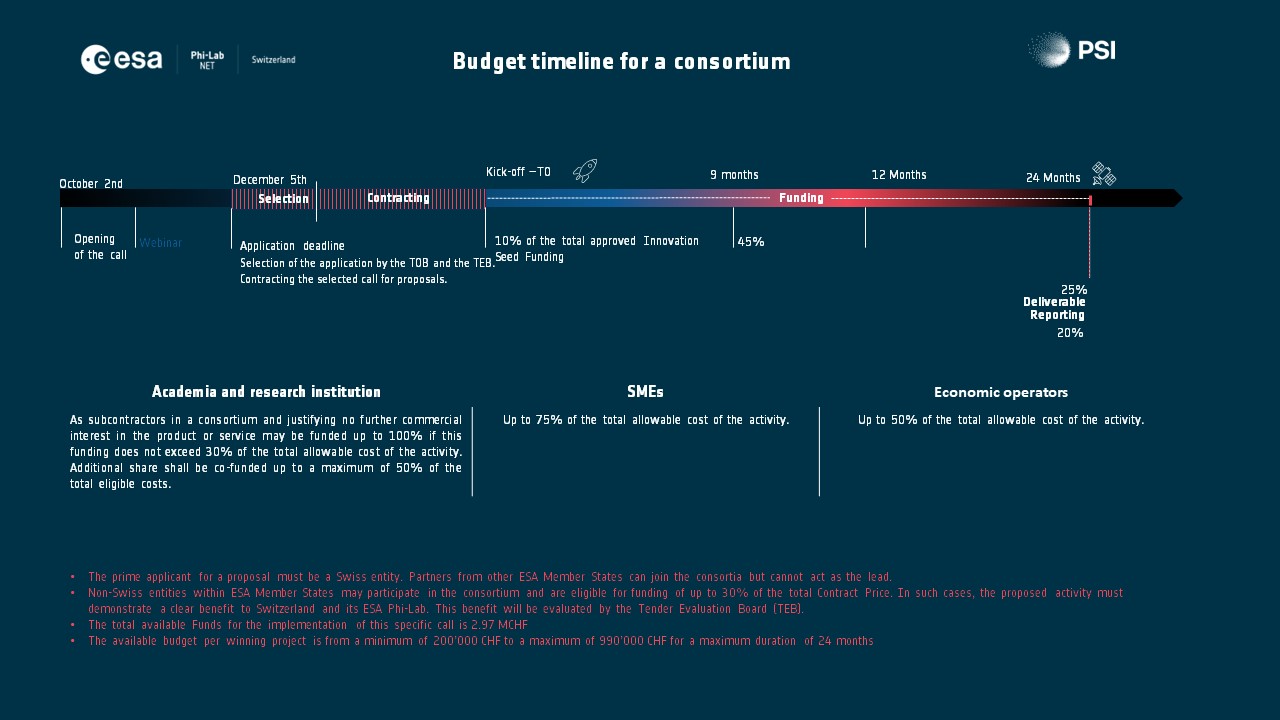
Download: Funding cycle for the Materials call
Have a look at the overiew of the funding cycle for a selected proposals.
For any question according to the funding please check the attached document on the OSIP webpage or contact: markus.schoelmerich@psi.ch.