Your research platform for out-of-this-world innovation.
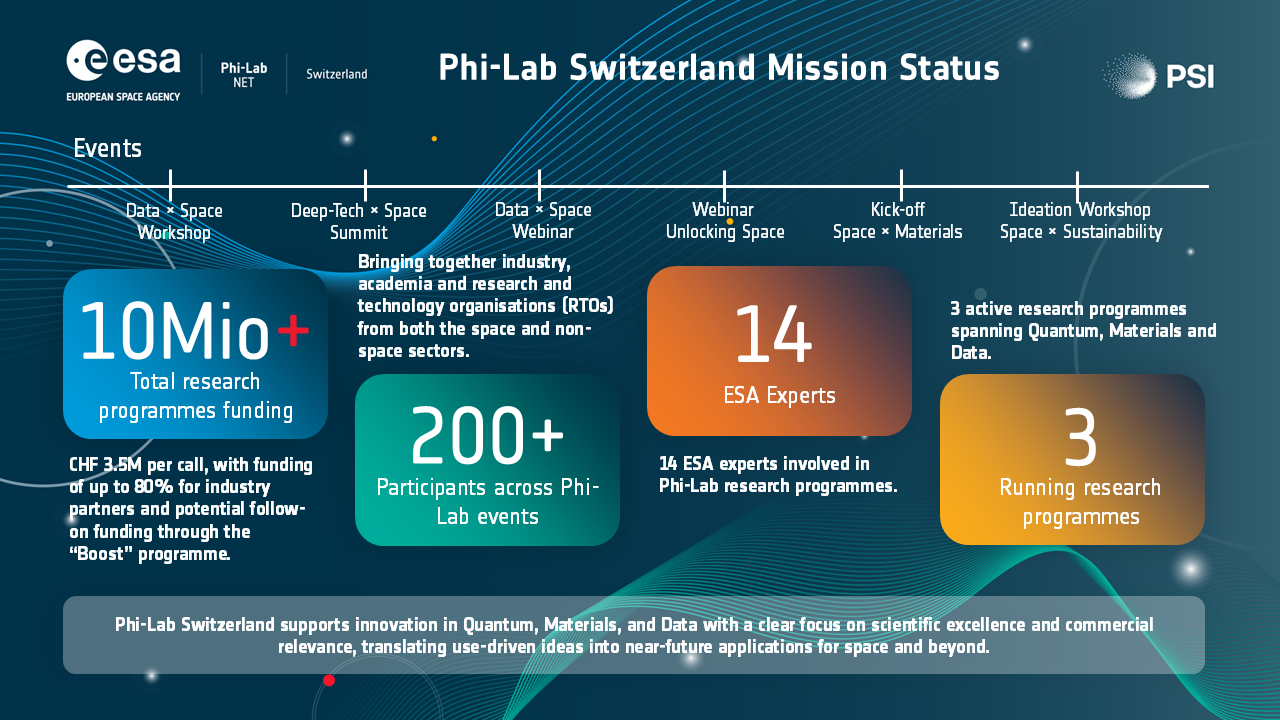
Check the ESA Phi-Lab research programme’s status and key figures and discover quarterly how ESA Phi-Lab Switzerland contributes to the space and deep-tech landscape. Find more details about ESA Phi-Lab projects on their respective pages.
Unlocking Space
Research Programs
Phi-lab
Quantum
What if every satellite could carry a quantum sensor the size of a shoebox?
In this new video interview, meet the ESA Phi-Lab Switzerland programme managers as they answer 5 questions about their mission, their approach and the work they do.
ESA Phi-Lab at ESDI
The ESA Phi-Lab at the European Space Deep-Tech Innovation Centre (ESDI) aspires to transform breakthrough science into real-world solutions. The approach based on use-inspired research, combined with deep-tech competence in our ecosystem, promises that developments are scientifically excellent, commercially relevant and have potential market impact. We expect that this accelerates progress from laboratory demonstrations to market-ready products that meet the demanding standards of space, but also terrestrial applications.
Accelerate
work on deep-tech conundrums worth solving
involve
diverse stakeholder communities
attract
newcomers for participation in research activities
ESA Phi-LabNET
Phi-Lab Switzerland is part of the ESA Phi-LabNET. If you’d like to learn more about funding opportunities across the network for your technology, get in touch with us and we’ll be happy to connect you with the appropriate Phi-Lab and the relevant contacts.
Deep-Tech x Sustainability
At ESDI, deep tech means “knowledge-rich technology at the frontier of science and engineering that pushes the boundaries of what’s possible.“
How does ESDI’s deep tech support sustainability on Earth? ESA and PSI both actively pursue sustainability. Learn more here:
Deep tech from ESDI powers sustainable solutions for both space and Earth:
Quantum technologies: Satellite-based quantum sensors detect fine changes in gravity, magnetism, and time helping with climate modeling, water monitoring, and environmental tracking.
Advanced materials: Self-repairing satellite parts extend mission lifetimes, reduce space debris, and lower environmental impact through fewer launches.
Data science: Intelligent analysis of satellite data enables predictive maintenance and optimizes systems—innovations that can be applied to energy and infrastructure on Earth.
These deep tech breakthroughs further ESA’s Strategy 2040, unlocking applications across agriculture, transportation, and climate monitoring.
For more info, check our FAQ or contact us directly.
Contact us
We appreciate your interest in ESDI. Kindly complete the form, and we will respond to your inquiry promptly.